Why Trace5G · for telecom teams, trainers and vendors
See inside a real 4G/5G network in minutes, not weeks.
No lab to book, no box to buy, no quote to wait for. Trace5G boots a real core, a real base
station and a real phone for you, in a browser, and decodes every message on every layer live, as the 3GPP
standards write it. 5G SA, 5G NSA and 4G LTE.
Every number on this page comes from a run that actually happened. Sources at the end of the page.
1 · A real trace is the most expensive view in telecom
Ask the simplest question, “why does the phone do that?”, and the honest answer today is a
purchase order or a booking. A real protocol trace needs a real network, and a real network is hardware, licences,
a room, and the one person who knows how to run it.
The week that follows one small question in a physical lab. A general description; no statistics are claimed.
What seeing a trace takes today
Four ways to get one, in the vendors’ own words. Good tools, each built for something else. Read 2026‑09‑13; sources below.
Route
What you see
What it takes
Price, as published
A network emulator in a box e.g. AMARI Callbox
A real base station and core in one box, for testing real phones over the air. “Selective logging and display of all layers of 3GPP LTE and NR stacks.”
The box, antennas, a test phone, an RF setup and someone to run it. “Lead time 4 weeks.”
A device-testing instrument: LTE, 5G NR SA and NSA, FR1 and FR2.
A bench, a device under test, and a specialist.
“Get a quote.” No price published.
A modem diagnostic tool e.g. QXDM
The over-the-air messages of one phone, as its modem saw them.
A licence from the chipset vendor, a phone with that chipset in diagnostic mode, a cable. Still no network of your own.
Licence price not published. Training “only available for QXDM licensees”.
A training lab e.g. Mpirical NetXlabs
A 5G core with a “device and gNB simulator” on a cloud instance; “Wireshark trace analysis”, tutorials, quizzes.
An account. Built for learning exercises, not for your own procedures or radio parameters.
£295 for 6 months, single licence.
Do it yourself open-source stacks
Real stacks if you build them: free software, radio hardware or an emulated link.
Your own integration time, then the expertise to keep it running. Logs in files; no analyzer.
Free software. The time is yours.
Sources: the vendors’ and resellers’ own pages, read 2026-09-13. The full list is at the end of the page. Trace5G’s own pricing is not discussed here.
The same routes on the two axes a buyer cares about: how real the network is, and how long until you see a trace. Placement is our reading of the pages above; Trace5G’s own numbers are on this page.
Also true
These are good tools for what they were built for. A callbox tests a real phone over RF, which Trace5G does not do. A modem tool shows the phone’s side of one link. A training lab teaches a procedure; Trace5G runs yours.
The box is not the expensive part. The waiting is.
2 · Today, and with Trace5G
Same team, same questions. What changes is where the network lives: in a room you book, or in a
browser tab that is yours for the run.
Left: a physical-lab workflow, described in general terms. Right: what trace5g.com does today.
3 · Your own real network, in a browser tab
Trace5G boots a real mobile core, a real base station and a real UE for every run, on a real
radio link, allocated to you alone, and streams the decoded trace into a live analyzer while the network is up.
Nothing is replayed, nothing is templated: you read the packets as they were sent.
Now you can ask the network directly, instead of asking for lab time.
Three things that are true on trace5g.com today.
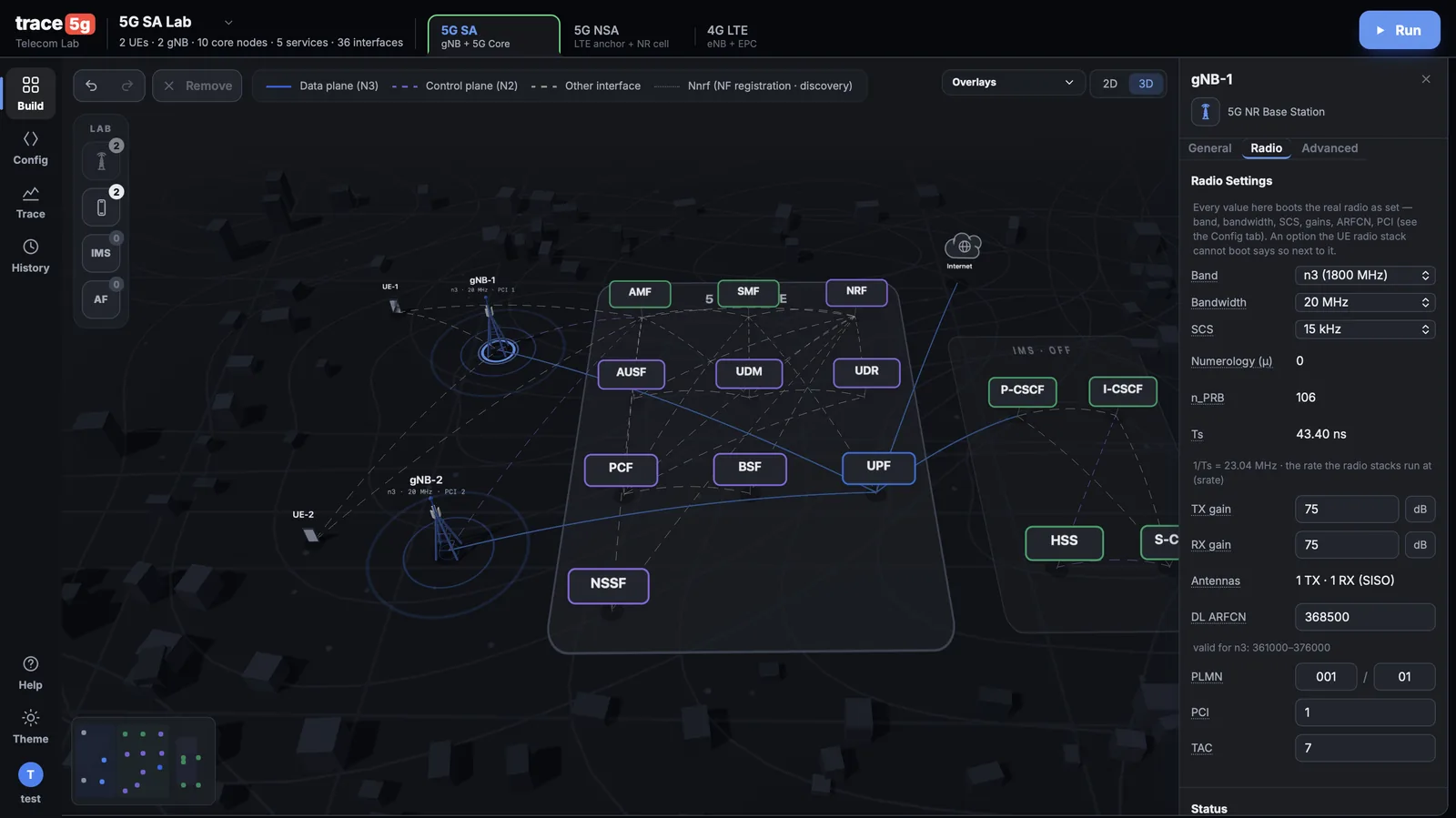
Your network, as you drew it: a phone, a cell, a full 5G core and voice services. Press Run and every box on this canvas becomes real.
Measured, not promised
A 5G SA run on trace5g.com went from pressing Run to the first decoded record in 1 m 40 s. Source:
trace5g.com/docs, “How a run works”, 2026‑09‑10.
4 · How easy, how fast
Nothing to install, nothing to buy, nothing to integrate. Three steps in a browser, and a real
network is yours for as long as you keep the run up. Change one thing, run again, compare: minutes, not a booking.
Compose the network, run it, investigate the trace. Optional steps run on the live network after it boots: a call, an SMS, a download, a failure, a handover.
Start from a preset (registration, a data session, a call, an SMS, an outage, a handover) or compose your own
steps, and keep them for the next run. Every finished run reopens from history exactly as it was: the same table,
ladder, decodes and KPIs.
5 · Real 3GPP standards, every single detail
This is where a marketing page usually gets vague. Ours cannot, because the product is the
evidence. Every message is decoded against the 3GPP definitions and shown down to the leaf: the information
element tree, the bytes on the wire, the same record as JSON and as text. Twelve layers from the radio to the
core, 34 interfaces, 52 specifications referenced next to the procedures.
Not a rendering of what should have happened. The packets, as they were sent.
6 · Who it’s for
Three kinds of people, one private network each.
Protocol engineers. Now you can reproduce the exact procedure under the radio parameters you choose, inject a failure and read every layer on one clock.
Teams and labs. Now you can give every engineer a private network instead of a slot on a shared one, and hand a review the trace instead of a story.
Educators and students. Now you can turn a procedure from the standard into a live experiment each learner runs, and reopens.
These are our promises, written from the customer’s side. They are not customer quotes; there are none yet.
7 · What changes for your team
Four things a team gets back, each built on something the platform already does today. Trace5G publishes no
ROI claims: your numbers come out of your own runs, measured on your own questions.
Faster answers, safer changes, fewer hours per case, no rack to own.